
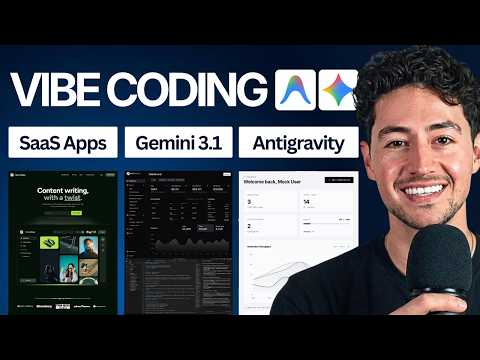
Vibe Coding: Gemini 3.1 & Antigravity for Rapid Dev
Deep dive into Vibe Coding, a methodology using Gemini 3.1 and the Antigravity framework for AI-accelerated product development. Learn rapid iteration, user feedback integration, and strategic application for developers and power users. See the full setup guide.

🛡️ What Is Vibe Coding?
Vibe Coding is an advanced, AI-augmented methodology for rapid product development, integrating cutting-edge generative AI models like Gemini 3.1 with streamlined development frameworks such as Antigravity. It aims to significantly accelerate the journey from concept to validated product, focusing on continuous user feedback and intuitive iteration to achieve rapid product-market fit, particularly for entrepreneurs and "makers" seeking to guarantee customer acquisition.
Vibe Coding emphasizes an intuitive, AI-driven development flow, leveraging advanced models for code generation, design, and strategic insights while utilizing specialized frameworks to minimize operational friction and maximize iterative speed.
📋 At a Glance
- Difficulty: Intermediate to Advanced
- Time required: Conceptual understanding (2 hours), Practical implementation (weeks to months for full adoption)
- Prerequisites: Strong understanding of modern software development principles, familiarity with AI/ML concepts, experience with API integration, and a product-oriented mindset.
- Works on: Methodology applicable across various development stacks and operating systems (macOS, Windows, Linux) with AI model access (e.g., via cloud APIs or local inference).
⚠️ Important Contextual Note: This guide interprets "VIBE CODING FULL COURSE: Gemini 3.1 + Antigravity (6 Hrs)" as a conceptual framework due to the absence of the detailed video transcript. Specific commands, exact API endpoints, and direct configuration steps from the course are not available here. Instead, this guide outlines the methodology, strategic implications, and general technical approaches based on the stated topics and common practices in AI-assisted development.
How Does Vibe Coding Leverage AI for Rapid Product Development?
Vibe Coding integrates advanced AI models, specifically Gemini 3.1, to transform traditional development into a highly iterative, feedback-driven process that prioritizes speed and user alignment. This methodology moves beyond simple code generation, using AI to assist in ideation, design, prototyping, automated testing, and even strategic market analysis, creating a continuous loop of creation and validation. The core idea is to maintain a "vibe" or intuitive alignment with user needs and market demand, using AI as an intelligent co-pilot to manifest that vision rapidly.
The essence of Vibe Coding lies in treating AI not just as a tool for automation but as an active participant in the creative and problem-solving process. By coupling a powerful model like Gemini 3.1 with a friction-reducing framework like Antigravity, developers can iterate on ideas at an unprecedented pace. This approach is particularly effective for "makers" and entrepreneurs who need to quickly validate product concepts and secure early adopters, reducing the time and resources typically required to achieve product-market fit. The focus shifts from meticulous, long-cycle planning to agile, AI-accelerated experimentation.
Phase 1: AI-Augmented Ideation and Problem Definition
What: Define the problem space and initial product concept using AI for brainstorming and market analysis. Why: To quickly generate and refine product ideas, identify potential user pain points, and assess market viability before significant development. This reduces the risk of building unwanted features. How: Use Gemini 3.1 (or similar advanced LLM) to:
- Generate problem statements: Prompt the AI with broad industry areas or user demographics.
- Brainstorm solutions: Provide the AI with identified problems and ask for diverse solution concepts, including unique angles.
- Analyze market fit: Query the AI for competitive landscape, potential user segments, and initial validation strategies.
# Conceptual AI prompt for ideation
prompt = """
As an experienced product manager and startup founder, generate 5 innovative product ideas
for the 'sustainable urban living' market. For each idea, provide:
1. A concise problem statement.
2. A unique solution concept leveraging AI or IoT.
3. A target user persona.
4. Key features (3-5).
5. A preliminary market validation strategy.
Focus on solutions that can achieve 'customer #1 guaranteed' quickly.
"""
# Assuming a Gemini 3.1 API call (illustrative)
# response = gemini_api.generate_content(prompt, model="gemini-3.1-pro")
# print(response.text)
Verify: Review the AI's output for novel insights, feasibility, and alignment with the initial "vibe" or mission.
✅ What you should see: A list of well-structured product ideas, each with a problem, solution, target, features, and validation strategy.
Phase 2: Rapid Prototyping and Design Synthesis
What: Quickly generate functional prototypes and design mockups based on refined ideas. Why: To visually and functionally test concepts with potential users without investing heavily in full-scale development. This allows for early feedback and course correction. How: Leverage Gemini 3.1's multimodal capabilities (hypothetically) for:
- UI/UX generation: Provide high-level descriptions or sketches, and ask the AI to generate wireframes, mockups, or even frontend code snippets.
- Backend scaffolding: Instruct the AI to generate basic API structures, database schemas, and initial business logic based on feature requirements.
- Interactive prototypes: Use AI to stitch together generated components into a clickable, albeit rudimentary, prototype.
// Conceptual AI prompt for UI/UX generation
// This would likely involve a more sophisticated multimodal input/output
prompt = """
Generate a responsive web UI for a 'sustainable urban living' app dashboard.
It should display:
- User's energy consumption (graph)
- Water usage (meter)
- Public transport options nearby
- Community events feed
Use a clean, modern aesthetic with a focus on green/blue color palette.
Provide HTML, CSS, and basic JavaScript for interactivity.
"""
// response = gemini_api.generate_content(prompt, model="gemini-3.1-vision-pro")
// console.log(response.text) // Contains generated code
Verify: Deploy the prototype to a testing environment or share it with a small group of target users. Gather initial feedback on usability and concept appeal.
✅ What you should see: A functional, albeit basic, prototype that visually represents the product idea and allows for basic interaction.
What Role Does Gemini 3.1 Play in the Vibe Coding Workflow?
Gemini 3.1, as a hypothetical advanced multimodal AI model, acts as the central intelligence in the Vibe Coding workflow, providing capabilities across the entire development spectrum from ideation to deployment and optimization. Its role extends beyond simple code completion to encompass complex problem-solving, creative generation, and dynamic adaptation based on real-time input. This level of AI integration is crucial for achieving the "antigravity" effect of frictionless development.
The power of Gemini 3.1 in Vibe Coding stems from its assumed ability to understand context, generate diverse outputs (text, code, images, potentially even executable components), and learn from interactions. This allows it to interpret high-level product requirements, translate them into technical specifications, generate significant portions of the codebase, and even suggest improvements or alternative approaches. Its multimodal nature would enable it to process and generate various data types required in a comprehensive product development cycle, making it an indispensable partner in the Vibe Coding process.
Core Capabilities of Gemini 3.1 in Vibe Coding:
-
Multimodal Understanding and Generation:
- What: Interpreting diverse inputs (text, images, audio, video, code) and generating coherent, contextually relevant outputs in multiple modalities.
- Why: Enables seamless translation between product requirements (often textual or visual) and technical implementation (code, design assets), and vice-versa.
- How: For example, feeding Gemini 3.1 a user story (text) alongside a rough sketch (image) to generate a detailed UI component (code + image).
- Verify: Check if the generated output accurately reflects all input modalities and maintains logical consistency.
✅ What you should see: AI-generated code snippets or design assets that align with both textual descriptions and visual references provided.
-
Intelligent Code Synthesis and Refactoring:
- What: Generating complex code blocks, functions, or entire modules from high-level prompts, and refactoring existing code for efficiency, readability, or security.
- Why: Drastically reduces manual coding effort, accelerates feature implementation, and maintains code quality.
- How: Provide Gemini 3.1 with a function signature and a natural language description of its purpose, or a block of legacy code with instructions to optimize it.
# Conceptual AI prompt for code synthesis prompt = """ Generate a Python FastAPI endpoint that: - Accepts a POST request with a JSON payload containing 'user_id' (int) and 'item_id' (int). - Validates that both IDs are positive integers. - Simulates adding an item to a user's cart (e.g., by printing a message). - Returns a JSON response indicating success or failure with appropriate HTTP status codes. Include Pydantic models for request body validation. """ # response = gemini_api.generate_code(prompt, lang="python", framework="fastapi") # print(response.code)Verify: Run the generated code with various inputs (valid, invalid) and observe its behavior and output. Ensure it meets the specified requirements.
✅ What you should see: Clean, functional code that handles input validation and logic as requested, with appropriate error handling.
-
Automated Testing and Debugging Assistance:
- What: Generating unit tests, integration tests, and suggesting debugging steps or fixes for identified issues.
- Why: Ensures code quality, catches bugs early, and reduces the manual effort of writing comprehensive tests.
- How: Feed Gemini 3.1 a code module and ask it to generate test cases, or provide an error trace and ask for potential solutions.
- Verify: Execute the AI-generated tests against the codebase. If debugging, apply suggested fixes and re-run.
✅ What you should see: Passing test suites, or clear, actionable suggestions for debugging and resolving code errors.
-
Strategic Insights and Market Validation:
- What: Analyzing product ideas, user feedback, and market data to provide strategic recommendations for pivoting, feature prioritization, or marketing.
- Why: Keeps the product aligned with market needs and customer desires, directly contributing to the "customer #1 guaranteed" objective.
- How: Feed Gemini 3.1 raw user interview transcripts, analytics data, or competitor reports and ask for actionable insights.
- Verify: Cross-reference AI insights with human analysis and real-world data.
✅ What you should see: Well-reasoned strategic recommendations, backed by data, that inform product direction.
How Does the Antigravity Framework Streamline Product-Market Fit?
The Antigravity framework, in the context of Vibe Coding, represents a set of tools, principles, and automated workflows designed to eliminate friction in the product development lifecycle, enabling rapid iteration and direct validation with users. Its primary goal is to accelerate the path to product-market fit by minimizing operational overhead, automating repetitive tasks, and providing instant feedback loops. This allows developers and product owners to focus almost exclusively on the "vibe" of the product and its alignment with user needs.
The "Antigravity" metaphor implies lifting the heavy burden of infrastructure management, deployment complexities, and manual feedback collection. It acts as an intelligent orchestrator, leveraging AI capabilities (like Gemini 3.1) to automate processes that typically consume significant time and resources. This includes everything from setting up development environments to deploying prototypes, collecting user analytics, and even synthesizing feedback into actionable development tasks. The framework is designed to be highly configurable yet deeply integrated, creating a seamless flow from idea to validated user experience.
Key Pillars of the Antigravity Framework (Conceptual):
-
Automated Environment Provisioning:
- What: Instantaneous setup of development, staging, and production environments tailored to the project's needs.
- Why: Eliminates manual configuration time and ensures consistency across environments, reducing "it works on my machine" issues.
- How: A simple command or AI prompt to define project requirements, and the framework automatically provisions cloud resources, installs dependencies, and configures services.
# Conceptual Antigravity CLI command for environment setup # antigravity env create --project-name "UrbanSustain" --stack "FastAPI,React,PostgreSQL" --region "us-east-1"Verify: Access the provisioned environment via URL or SSH. Check installed services and configurations.
✅ What you should see: A fully operational, pre-configured development environment ready for code deployment.
-
Continuous AI-Driven Deployment (CAID):
- What: Automated deployment of code changes to various environments, with AI assisting in release management, testing, and rollback strategies.
- Why: Enables rapid iteration by making deployment a non-event, allowing for frequent releases and quick testing of new features or bug fixes.
- How: Code pushed to a specific branch triggers AI-assisted build, test, and deployment pipelines. AI might suggest optimal release times or flag potential conflicts.
# Conceptual Antigravity CI/CD configuration snippet # .antigravity/pipeline.yaml on: push: branches: - main - feature/* jobs: build-and-deploy: runs-on: ubuntu-latest steps: - uses: actions/checkout@v3 - name: AI-assisted build run: antigravity build --ai-optimize - name: AI-driven tests run: antigravity test --ai-coverage - name: Deploy to staging run: antigravity deploy --env staging --ai-approvalVerify: Monitor the deployment pipeline logs. Access the deployed application in the target environment.
✅ What you should see: Automated deployment complete, and the latest code changes reflected in the application.
-
Integrated User Feedback and Analytics Loop:
- What: Seamless collection of user behavior data, direct feedback, and AI-powered analysis to generate actionable insights.
- Why: Directly informs product iteration, ensures features are aligned with user needs, and accelerates the validation of "customer #1 guaranteed."
- How: The framework integrates analytics tools, user session recording, and feedback widgets. AI (Gemini 3.1) processes this raw data into summaries, sentiment analysis, and feature suggestions.
# Conceptual Antigravity API call for feedback synthesis # feedback_data = antigravity_api.get_raw_feedback(last_24_hours=True) # prompt = f"Analyze this user feedback for common themes and actionable feature requests:\n{feedback_data}" # insights = gemini_api.generate_content(prompt) # print(insights.text)Verify: Review the AI-generated feedback summaries and feature suggestions. Compare with raw data to ensure accuracy.
✅ What you should see: Clear, prioritized list of user pain points and feature requests, ready for the next iteration.
-
AI-Driven Project Management and Task Generation:
- What: AI assists in breaking down product goals into actionable tasks, estimates effort, and manages project timelines.
- Why: Reduces project management overhead, keeps the team focused, and ensures efficient resource allocation.
- How: Provide Gemini 3.1 with a high-level feature description, and it generates a list of sub-tasks, assigns them (hypothetically), and updates a project board.
- Verify: Check the project management tool for newly created tasks and updated timelines.
✅ What you should see: A structured list of actionable development tasks derived from a high-level feature request.
What Are the Core Principles and Iteration Loops of Vibe Coding?
Vibe Coding operates on a set of core principles that prioritize continuous alignment with user needs, rapid experimentation, and leveraging AI to amplify human creativity and efficiency. These principles guide the iterative loops within the methodology, ensuring that development remains agile, responsive, and constantly moving towards validated product-market fit. The "vibe" refers to an intuitive understanding of what users want and what the market demands, which is then rapidly manifested and tested.
The methodology is not merely about using AI for code generation; it's about fundamentally reshaping the development process into a highly responsive feedback system. The iterative loops are short, often measured in hours or days, and are designed to quickly move from concept to user interaction and back to refinement. This continuous flow, facilitated by Gemini 3.1 and the Antigravity framework, allows for dynamic adaptation and course correction, making the development process feel almost frictionless—hence the "antigravity" effect.
Core Principles:
-
User-Centric Intuition ("The Vibe"):
- What: Prioritizing an intuitive understanding of user needs and market demand, guiding all development decisions.
- Why: Ensures that products being built genuinely solve problems and resonate with the target audience, crucial for securing "customer #1."
- How: Constant engagement with early users, direct feedback channels, and AI-powered sentiment analysis of interactions.
- Verify: Observe user engagement metrics and direct feedback. Does the product feel "right" to its users?
✅ What you should see: High user satisfaction and engagement metrics, positive qualitative feedback.
-
AI-Augmented Creativity and Efficiency:
- What: Using AI (Gemini 3.1) to enhance human creativity, automate repetitive tasks, and provide intelligent suggestions across the development lifecycle.
- Why: Accelerates development speed, reduces cognitive load on developers, and allows focus on higher-level problem-solving.
- How: AI generates code, design elements, test cases, and strategic insights, freeing human developers to orchestrate and refine.
- Verify: Measure time saved on routine tasks and the quality/novelty of AI-generated content.
✅ What you should see: Significant reduction in development cycle time and improved output quality.
-
Frictionless Iteration (Antigravity Effect):
- What: Minimizing all forms of operational friction in the development, deployment, and feedback collection processes.
- Why: Enables extremely rapid cycles of build-measure-learn, allowing for quick pivots and continuous product evolution.
- How: Automated environments, CI/CD, integrated feedback loops, and AI-driven project orchestration provided by the Antigravity framework.
- Verify: Assess the time taken from a code commit to live deployment and user feedback collection.
✅ What you should see: Deployment cycles measured in minutes, and feedback synthesis in hours.
-
Data-Driven Validation and Adaptation:
- What: Basing product decisions on empirical data from user interactions and market analysis, with a readiness to adapt or pivot.
- Why: Ensures product development is grounded in reality, not assumptions, leading to more successful outcomes.
- How: AI analyzes user analytics, A/B test results, and market trends to provide actionable insights.
- Verify: Track key performance indicators (KPIs) and observe how product changes impact them.
✅ What you should see: Product iterations that consistently improve user engagement or conversion metrics.
The Vibe Coding Iteration Loop:
-
Conceptualize (AI-Assisted):
- What: Define a micro-feature or hypothesis based on "the vibe" and previous feedback.
- Why: To have a clear, testable unit of work for the iteration.
- How: Prompt Gemini 3.1 with a problem, desired outcome, and target user.
- Verify: A concise, well-defined feature specification or hypothesis.
-
Generate & Build (AI-Driven):
- What: Use Gemini 3.1 to generate code, design elements, and tests for the micro-feature.
- Why: Rapidly produce a functional, testable increment.
- How: Provide the AI with the conceptualized output from step 1.
- Verify: Functional code and design assets that pass initial AI-generated tests.
-
Deploy (Antigravity-Automated):
- What: Automatically deploy the new increment to a live or staging environment.
- Why: Make the feature available for immediate user interaction and data collection.
- How: Leverage Antigravity's CI/CD pipeline.
- Verify: The feature is live and accessible.
-
Measure & Analyze (AI-Integrated):
- What: Collect user interaction data and direct feedback, then use AI to analyze it.
- Why: Understand how users interact with the new feature and identify areas for improvement.
- How: Antigravity's integrated analytics and feedback tools feed data to Gemini 3.1 for synthesis.
- Verify: Comprehensive reports on feature usage, user sentiment, and potential issues.
-
Refine & Adapt (AI-Informed):
- What: Based on AI analysis, refine the feature, pivot the approach, or discard the feature.
- Why: Close the feedback loop and ensure continuous improvement and alignment with "the vibe."
- How: Use AI suggestions to guide the next conceptualization phase.
- Verify: Clear decisions made on the feature's future, leading to the next iteration.
When Vibe Coding Is NOT the Right Choice for Your Project
While Vibe Coding offers compelling advantages for rapid product development and achieving product-market fit, it is not a universal solution. There are specific scenarios and project types where its inherent characteristics—heavy reliance on AI, rapid iteration, and a focus on speed—can become liabilities rather than assets. Understanding these limitations is crucial for making informed decisions about adopting this methodology. Adopting Vibe Coding without considering these factors can lead to increased complexity, security risks, or a loss of critical human oversight.
1. Projects Requiring Extreme Precision, Auditing, or Certification
- Limitation: AI-generated code, while often functional, may lack the nuanced precision, formal verification, or comprehensive documentation required for highly regulated industries (e.g., aerospace, medical devices, financial systems). The "vibe" approach prioritizes speed over exhaustive formal methods.
- Why not use Vibe Coding: These domains demand stringent quality control, provable correctness, and often manual, human-centric auditing processes that contradict the rapid, AI-driven nature of Vibe Coding. Errors in such systems can have catastrophic consequences.
- Alternative: Traditional, highly structured software engineering methodologies with rigorous formal verification, extensive manual code reviews, and comprehensive documentation processes are preferred.
2. Deeply Complex, Novel Algorithmic Research & Development
- Limitation: While AI can assist in generating code, it excels at patterns and existing solutions. For truly novel algorithmic research or highly specialized, cutting-edge scientific computing where no existing patterns or training data suffice, AI may struggle to provide truly innovative or optimal solutions.
- Why not use Vibe Coding: The creative breakthroughs in these areas often require deep human mathematical insight, theoretical understanding, and iterative experimentation that goes beyond current AI capabilities for pure generation.
- Alternative: Research-driven development, academic collaboration, and expert-led teams focusing on foundational innovation are more appropriate.
3. Projects with Strict Legacy System Integration & Constraints
- Limitation: Integrating with deeply entrenched, poorly documented, or highly idiosyncratic legacy systems often requires specific, meticulous human understanding of archaic technologies and complex dependencies. AI might struggle to navigate these unique constraints effectively without extensive, specialized fine-tuning and human guidance.
- Why not use Vibe Coding: The "antigravity" effect is diminished when dealing with systems that inherently create significant friction. AI-generated solutions might not seamlessly conform to the specific quirks and limitations of older architectures.
- Alternative: Expert-led integration teams with deep domain knowledge of the legacy systems, focusing on meticulous API design, data migration, and careful phased rollouts.
4. Projects Where Security and Privacy Are Paramount and Non-Negotiable
- Limitation: While AI can generate secure code, the sheer volume and speed of AI-generated output in Vibe Coding can make comprehensive security auditing challenging. Potential vulnerabilities (e.g., prompt injection, data leakage from training models, or subtly flawed AI-generated logic) might be harder to detect at scale.
- Why not use Vibe Coding: In applications handling sensitive data (e.g., national security, critical infrastructure, personal health information), even minor AI-induced vulnerabilities are unacceptable. The rapid iteration might inadvertently bypass critical security gates if not meticulously managed.
- Alternative: Security-by-design methodologies, extensive penetration testing, manual security audits, and dedicated security engineering teams are essential.
5. Teams Lacking AI Literacy or Strong Human Oversight
- Limitation: Vibe Coding requires developers and product owners to be highly "AI literate"—understanding AI's capabilities, limitations, and how to effectively prompt and validate its output. Without this, there's a risk of blindly accepting AI suggestions, leading to suboptimal or incorrect solutions.
- Why not use Vibe Coding: Over-reliance on AI without critical human oversight can lead to "AI hallucinations" manifesting in production code, perpetuating biases, or creating technically sound but strategically misaligned features.
- Alternative: Start with smaller, more controlled AI integration projects, invest heavily in AI literacy training, and gradually increase AI's role as the team gains experience and confidence.
Frequently Asked Questions
What distinguishes Vibe Coding from traditional agile or lean methodologies? Vibe Coding integrates advanced AI, like Gemini 3.1, directly into the rapid iteration and feedback loops, emphasizing intuitive development and immediate user validation to achieve product-market fit faster. It prioritizes continuous alignment with 'the vibe' of user needs and market demand, going beyond mere task automation to truly augment creative problem-solving and strategic decision-making.
How does the Antigravity framework handle version control and collaboration in an AI-driven environment? While specific details from the course are unavailable, the Antigravity framework, in theory, would abstract away much of the traditional friction in version control and collaboration. This could involve AI-driven branch management, automated merge conflict resolution suggestions, and real-time code synthesis that integrates contributions from multiple sources (human and AI) into a coherent codebase. Its goal is to minimize overhead, allowing developers to focus on product iteration rather than infrastructure.
What are the common pitfalls when implementing Vibe Coding without a clear product vision? Without a clear product vision, Vibe Coding can lead to rapid iteration on irrelevant features, 'AI-driven scope creep,' and a lack of coherent direction. The efficiency of AI and the Antigravity framework can accelerate movement in the wrong direction if the foundational problem statement and target user needs are not well-defined. Over-reliance on AI without critical human oversight can also result in technically sound but strategically misaligned products, wasting valuable resources and time.
Quick Verification Checklist
- Understand the core Vibe Coding principles: User-Centric Intuition, AI-Augmented Creativity, Frictionless Iteration, Data-Driven Validation.
- Identify how Gemini 3.1 (or similar advanced LLM) can be integrated into your ideation, coding, and testing phases.
- Conceptualize how a framework like Antigravity could automate your environment provisioning, CI/CD, and feedback loops.
- Assess whether your current project's requirements align with the strengths of Vibe Coding, or if its limitations suggest an alternative approach.
Related Reading
- No-Code AI Agents in 2026: A Practical Guide
- Spec-Driven Development: AI Assisted Coding Explained
- Mastering Claude Skills: Beyond Basic Tool Use
Last updated: July 30, 2024
Related Reading
RESPECTS
Submit your respect if this protocol was helpful.
COMMUNICATIONS
No communications recorded in this log.