

Spec-Driven Development: AI Assisted Coding Explained
Explore spec-driven development with AI assistance, its workflow, benefits, and challenges for robust software. See the full conceptual guide.

🛡️ What Is Spec-Driven Development with AI Assistance?
Spec-Driven Development (SDD) with AI Assistance is a methodology where software creation begins with a precise, often machine-readable, specification document that details system behavior, interfaces, and constraints. AI assistance augments this process by generating code, tests, and documentation directly from these specifications, accelerating development cycles and ensuring strict adherence to design. This approach targets developers and architects aiming for high consistency, reduced errors, and faster time-to-market by leveraging AI to bridge the gap between abstract design and concrete implementation.
Spec-driven development, enhanced by AI, enables rapid prototyping and robust system construction by translating formal requirements into executable artifacts with intelligent automation.
📋 At a Glance
- Difficulty: Intermediate
- Time required: N/A (conceptual guide; implementation time varies widely depending on project scope and tooling)
- Prerequisites: Fundamental understanding of software development methodologies (e.g., Agile, Waterfall), API design principles, basic AI/ML concepts, experience with version control systems, and familiarity with formal specification languages (e.g., OpenAPI, AsyncAPI, UML).
- Works on: Applicable across various development environments and programming languages, integrating conceptually with AI platforms such as IBM watsonx.
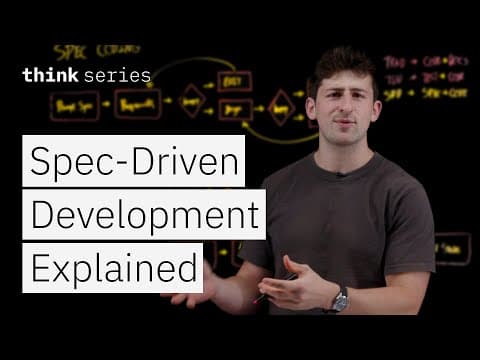
⚠️ Important Note on Video Context: The source video, "Spec-Driven Development: AI Assisted Coding Explained" by IBM Technology, is a conceptual overview and promotional material for a "watsonx AI Assistant Engineer" certification. It focuses on explaining the methodology and its benefits rather than providing specific, actionable setup instructions, code examples, or tool-specific commands. This guide elaborates on the concepts presented, offering practical insights into implementing such a methodology, but does not invent technical steps or commands not present in the source material.
What is Spec-Driven Development (SDD) and Why Does It Matter?
Spec-Driven Development (SDD) is a software engineering paradigm that prioritizes creating comprehensive, unambiguous specifications before writing implementation code. This approach ensures that all stakeholders, from product managers to developers and testers, operate from a shared, consistent understanding of the system's intended behavior, interfaces, and constraints. By formalizing requirements upfront, SDD significantly reduces ambiguity, minimizes rework, and improves the overall quality and maintainability of software systems.
SDD matters because it fosters clarity, consistency, and correctness throughout the software lifecycle. It mandates a rigorous definition phase, leading to more predictable outcomes, easier collaboration, and a clearer path for validation and testing.
Key Principles of Spec-Driven Development
What: SDD is founded on several core principles that differentiate it from more ad-hoc or code-first approaches. These principles guide the entire development process, from initial design to deployment and maintenance.
Why: Adhering to these principles ensures that the benefits of SDD—such as reduced errors, improved collaboration, and maintainable codebases—are fully realized. They establish a disciplined framework for building robust software.
- Specification as the Single Source of Truth:
- What: The formal specification document is the definitive reference for how the system should behave. All code, tests, and documentation must derive from and align with this specification.
- Why: This prevents discrepancies between design and implementation, ensuring that everyone involved refers to the same authoritative document. It eliminates guesswork and reduces miscommunication.
- Early Detection of Design Flaws:
- What: By focusing on detailed specifications early in the lifecycle, potential design issues, inconsistencies, or ambiguities are identified and resolved before any code is written.
- Why: Addressing problems at the design stage is significantly less costly and time-consuming than fixing them during coding, testing, or post-release. This proactive approach saves resources and avoids costly rework.
- Automated Code and Test Generation (Traditional SDD):
- What: Historically, SDD has leveraged tools to generate boilerplate code (e.g., API stubs, data models) and initial test cases directly from formal specifications.
- Why: This automation accelerates development, ensures adherence to the specification, and reduces the manual effort required for repetitive coding tasks. It also guarantees that generated code patterns are consistent.
- Improved Collaboration and Communication:
- What: Specifications serve as a common language and artifact for product owners, designers, developers, and QA engineers, facilitating precise communication.
- Why: Clear, formal specifications minimize misinterpretations and foster better alignment across diverse teams. This shared understanding reduces friction and improves project velocity.
- Enhanced Testability and Validation:
- What: Specifications provide clear criteria for testing. Automated tests can be derived directly from these specs, ensuring that the system is validated against its intended behavior.
- Why: This makes testing more systematic, comprehensive, and traceable back to requirements. It increases confidence that the software correctly implements its design.
✅ Expected Outcome: A well-defined, formal specification document (e.g., an OpenAPI definition for an API, a UML model for system architecture) that is clear, consistent, and agreed upon by all stakeholders. This document serves as the foundation for all subsequent development activities.
How Does AI Revolutionize Spec-Driven Development Workflows?
Artificial Intelligence fundamentally transforms Spec-Driven Development by automating and enhancing various stages of the development lifecycle, moving beyond traditional template-based code generation to intelligent, context-aware assistance. AI models, particularly large language models (LLMs), can interpret natural language or semi-formal specifications, generate more complex and nuanced code, suggest design improvements, and even create comprehensive test suites and documentation. This integration significantly boosts developer productivity, reduces manual toil, and further reinforces consistency between specification and implementation.
AI revolutionizes SDD by adding intelligent automation, enabling faster translation of specifications into executable artifacts, and providing proactive insights throughout the development process.
AI's Impact on SDD Stages
What: AI can be integrated at multiple points within the SDD workflow, providing capabilities that were previously manual or limited to rigid rule-based automation.
Why: Leveraging AI at these stages optimizes the development process, increases efficiency, and improves the quality of generated artifacts, allowing developers to focus on higher-level design and problem-solving.
- Specification Refinement and Validation:
- What: AI can analyze initial, potentially informal, specifications for ambiguities, inconsistencies, or gaps. It can suggest formalizing natural language requirements into structured formats (e.g., converting user stories into Gherkin syntax or OpenAPI definitions).
- Why: This helps create higher-quality, machine-interpretable specifications from the outset, reducing the risk of misinterpretation by subsequent AI code generation steps or human developers.
- How (Conceptual): Feed natural language requirements into an LLM. Prompt it to identify ambiguities and suggest formalizations.
# Conceptual AI prompt for spec refinement
Analyze the following user story for ambiguities and suggest a more formal, structured representation (e.g., Gherkin or OpenAPI snippet):

"As a user, I want to be able to search for products by name or category, and see their prices. If a product is out of stock, it shouldn't show up."
✅ Expected Output: AI-suggested formalizations, e.g., "Given a user is on the product search page, When they search for 'laptop' in 'Electronics' category, Then they should see available laptops with prices, And no out-of-stock products should be displayed."
- Intelligent Code Generation:
- What: Beyond simple stub generation, AI can generate significant portions of implementation code (e.g., API endpoints, database models, business logic) directly from detailed specifications. This includes generating code in specific frameworks or languages, adhering to coding standards.
- Why: This drastically accelerates the coding phase, reduces boilerplate, and ensures the generated code precisely matches the specification, minimizing human error in translation.
- How (Conceptual): Provide a formal specification (e.g., OpenAPI YAML) to an AI code generation model. Specify the target language and framework.
# Conceptual OpenAPI snippet
paths:
  /products:
    get:
      summary: List all products
      operationId: listProducts
      parameters:
        - in: query
          name: category
          schema:
            type: string
          description: Filter by product category
        - in: query
          name: inStock
          schema:
            type: boolean
            default: true
          description: Only show in-stock products
      responses:
        '200':
          description: A list of products
          content:
            application/json:
              schema:
                type: array
                items:
                  $ref: '#/components/schemas/Product'
✅ Expected Output: AI-generated server-side code (e.g., Python Flask or Java Spring Boot) for the
/productsendpoint, including request parsing, database query logic (conceptual), and response serialization, based on the provided spec.
- Automated Test Case Generation:
- What: AI can infer and generate comprehensive unit tests, integration tests, and even end-to-end test scenarios directly from specifications, covering various edge cases and success paths.
- Why: This ensures thorough test coverage aligned with requirements, reduces the manual effort of test writing, and helps catch bugs early in the development cycle.
- How (Conceptual): Provide the formal specification and potentially the AI-generated code to a test generation model.
# Conceptual AI prompt for test generation
Generate unit tests (JUnit/pytest) for the `listProducts` endpoint based on the OpenAPI specification and the generated code. Include tests for:
- Successful retrieval with no filters.
- Filtering by category.
- Filtering by in-stock status.
- Handling invalid parameters.
✅ Expected Output: AI-generated test code (e.g., Python
pytestor JavaJUnit) verifying thelistProductsendpoint's behavior against the specification.
- Documentation Generation and Synchronization:
- What: AI can automatically generate and keep documentation (e.g., API reference, user manuals, internal design documents) synchronized with the evolving specifications and code.
- Why: This ensures documentation is always up-to-date, reduces the burden on developers to manually maintain it, and improves the usability and understanding of the system.
- How (Conceptual): Provide the formal specification and generated code to an AI documentation model.
# Conceptual AI prompt for documentation
Generate a comprehensive API reference document (Markdown) for the `/products` endpoint based on its OpenAPI specification.
✅ Expected Output: Markdown documentation describing the
/productsendpoint, its parameters, responses, and example usage, consistent with the OpenAPI spec.
Implementing AI-Assisted Spec-Driven Development: A Conceptual Workflow
Implementing AI-assisted Spec-Driven Development involves a structured, iterative workflow that integrates AI capabilities at critical junctures, moving from high-level requirements to executable, validated software. This conceptual workflow emphasizes the definition of precise specifications as the foundation, with AI serving as an intelligent co-pilot for generation, validation, and refinement throughout the development process. The core idea is to leverage AI to automate the translation of intent (specifications) into artifacts (code, tests, docs), while maintaining human oversight for strategic decisions and quality assurance.
This workflow conceptually outlines the process of leveraging AI to streamline the journey from abstract requirements to concrete, tested software, emphasizing iterative refinement and continuous validation.
Conceptual Workflow Steps
What: Each step in this workflow builds upon the previous one, with AI playing a role in accelerating and enhancing the output.
Why: Following a structured workflow ensures that the benefits of both SDD and AI assistance are maximized, leading to efficient development and high-quality outcomes.
-
Define Business Requirements and High-Level Design:
- What: Begin by gathering business requirements and outlining the system's high-level architecture. These are often in natural language, user stories, or initial diagrams.
- Why: This foundational step establishes the "what" and "why" of the project, providing the initial context for formal specification.
- How (Conceptual): Stakeholder interviews, brainstorming sessions, creating user stories.
- Verify: A clear, concise set of high-level requirements and architectural overview document.
-
Formalize Specifications with AI Assistance:
- What: Translate high-level requirements into precise, formal specifications using structured languages (e.g., OpenAPI for REST APIs, AsyncAPI for event-driven systems, Gherkin for behavior-driven development, UML for system models). AI can assist in this formalization process.
- Why: Formal specifications are machine-readable, unambiguous, and serve as the single source of truth for AI generation and human understanding.
- How (Conceptual):
- Human Action: Write initial formal specifications (e.g.,
api-spec.yaml). - AI Assistance: Use an LLM to review the specification for completeness, consistency, and potential ambiguities. Prompt the AI to suggest improvements or fill in missing details based on common patterns.
# Conceptual command for AI spec review
# Assuming a tool that interfaces with an AI model for spec analysis
ai-spec-analyzer review api-spec.yaml --format openapi --suggestions
⚠️ Warning: AI suggestions must be critically reviewed by a human expert. AI can hallucinate or misinterpret subtle nuances, leading to incorrect or insecure specifications if not validated.
- Human Action: Write initial formal specifications (e.g.,
- Verify: A validated, version-controlled formal specification document that is free of major ambiguities and inconsistencies.
-
Generate Code Stubs and Boilerplate with AI:
- What: Use AI to generate foundational code components directly from the formal specifications. This includes API interfaces, data models, initial service stubs, and basic CRUD operations.
- Why: This rapidly scaffolds the project, ensures immediate alignment with the specification, and frees developers from repetitive, error-prone boilerplate coding.
- How (Conceptual):
- Human Action: Initiate code generation specifying target language and framework.
# Conceptual command for AI code generation # Assuming a tool that interfaces with an AI model for code generation ai-code-generator generate --spec api-spec.yaml --language python --framework flask --output-dir ./src - Verify: Review the generated code for correctness, adherence to the spec, and basic functionality. Ensure it compiles and passes any initial static analysis checks.
-
Generate Test Cases with AI:
- What: Leverage AI to create a comprehensive suite of unit, integration, and potentially end-to-end tests based on the formal specifications and the generated code.
- Why: Automated test generation ensures high test coverage, validates the generated code against the specification, and catches defects early.
- How (Conceptual):
- Human Action: Initiate test generation, specifying the type of tests and target testing framework.
# Conceptual command for AI test generation # Assuming a tool that interfaces with an AI model for test generation ai-test-generator generate --spec api-spec.yaml --code-dir ./src --language python --framework pytest --output-dir ./tests - Verify: Run the generated tests. Ensure they pass for the correctly generated code and fail for expected error conditions. Review test coverage reports.
-
Human Augmentation and Refinement:
- What: Developers review, refine, and extend the AI-generated code and tests. This involves implementing complex business logic, optimizing performance, integrating with existing systems, and addressing any AI-generated errors or inefficiencies.
- Why: While AI excels at boilerplate, human expertise is crucial for nuanced logic, architectural decisions, security hardening, and ensuring the system meets non-functional requirements.
- How (Conceptual): Manual coding, pair programming, code reviews.
# Example of human refinement on AI-generated code (conceptual) # Original AI-generated: # def get_products(category: str = None, in_stock: bool = True): # # Basic database query placeholder # return [] # Human refinement: from database import get_db_session # Assuming this exists from models import Product # Assuming this exists def get_products(category: str = None, in_stock: bool = True): session = get_db_session() query = session.query(Product) if category: query = query.filter(Product.category == category) if in_stock: query = query.filter(Product.stock > 0) # Refined logic for 'in_stock' return query.all() - Verify: Thorough code reviews, manual testing, and performance profiling.
-
Generate and Synchronize Documentation with AI:
- What: Use AI to generate and continuously update API documentation, design documents, and user guides based on the formal specifications and the evolving codebase.
- Why: Ensures documentation remains accurate and up-to-date, reducing the manual effort of documentation maintenance and improving developer experience.
- How (Conceptual):
- Human Action: Trigger documentation generation.
# Conceptual command for AI documentation generation # Assuming a tool that interfaces with an AI model for documentation ai-doc-generator generate --spec api-spec.yaml --code-dir ./src --output-format markdown --output-dir ./docs - Verify: Review generated documentation for accuracy, completeness, and clarity.
-
Continuous Integration and Deployment (CI/CD):
- What: Integrate the AI-assisted SDD workflow into a robust CI/CD pipeline, automating builds, tests, and deployments whenever specifications or code change.
- Why: Ensures rapid feedback, continuous validation, and efficient delivery of software updates.
- How (Conceptual): Configure CI/CD tools (e.g., Jenkins, GitLab CI, GitHub Actions) to trigger AI generation steps, run tests, and deploy.
# Conceptual .gitlab-ci.yml snippet stages: - spec_validation - code_generation - test_generation - build_and_test - deploy spec_validation_job: stage: spec_validation script: - ai-spec-analyzer review api-spec.yaml code_generation_job: stage: code_generation script: - ai-code-generator generate --spec api-spec.yaml --language python --framework flask --output-dir ./src artifacts: paths: - src/ # ... other stages for test generation, build, test, deploy - Verify: Successful pipeline runs, automated deployments, and monitoring of deployed services.
How Does IBM watsonx Fit into Spec-Driven Development?
IBM watsonx, as an enterprise AI and data platform, conceptually provides the foundational services and tooling necessary to facilitate AI-assisted Spec-Driven Development, particularly for large organizations. While the source video is a high-level explanation and certification promotion, the watsonx platform is designed to offer capabilities for model development, data management, and AI governance. These capabilities are crucial for deploying and managing the generative AI models that power code, test, and documentation generation within an SDD workflow, especially in a secure and scalable enterprise context.
Watsonx conceptually supports AI-assisted SDD by providing an enterprise-grade platform for building, deploying, and managing the AI models that generate code, tests, and documentation from formal specifications.
Watsonx Capabilities Relevant to AI-Assisted SDD (Conceptual)
What: IBM watsonx is envisioned as a comprehensive platform encompassing AI tools, data governance, and foundation models. Its components would address key technical requirements for implementing AI-assisted SDD at scale.
Why: Leveraging an integrated platform like watsonx can streamline the management of AI models, ensure data security, and provide the computational resources needed for generative AI tasks within a corporate environment.
- watsonx.ai (AI Studio):
- What: Provides access to foundation models and tools for developing, training, and fine-tuning AI models. This is where the core generative AI capabilities for code, test, and documentation generation would reside.
- Why: Developers and AI engineers can select, adapt, or build specific LLMs optimized for code generation from formal specifications, ensuring they meet enterprise-specific coding standards and security requirements.
- How (Conceptual):
- Access pre-trained foundation models.
- Fine-tune models on proprietary codebases and specification-to-code mappings to improve accuracy and style.
- Develop custom prompts and prompt chains for specific generation tasks (e.g., "generate Python Flask code from this OpenAPI spec").
- Manage model versions and deployments.
""" generated_code = model.generate(prompt, max_tokens=2000, temperature=0.7) print(generated_code)# Conceptual Python snippet using a watsonx.ai client for code generation from watsonx_ai_sdk import GenerativeModel # Assuming 'code_gen_model_id' is a deployed model fine-tuned for code generation model = GenerativeModel(model_id="code_gen_model_id", credentials={"api_key": "YOUR_API_KEY"}) openapi_spec_content = """ # ... your OpenAPI YAML content ... """ prompt = f""" Generate Python Flask code for the following OpenAPI specification. Ensure it follows best practices for RESTful APIs and includes basic error handling. ```yaml {openapi_spec_content}> ✅ **Expected Output**: Python code generated by the fine-tuned AI model based on the provided OpenAPI specification.
- watsonx.data (Data Store):
- What: Offers a data store optimized for AI workloads, allowing for the storage and management of vast datasets. This is crucial for storing specifications, generated code, test results, and model training data.
- Why: Secure and scalable data storage is essential for training custom AI models, managing the artifacts produced by AI-assisted SDD, and providing audit trails.
- watsonx.governance (AI Governance):
- What: Provides tools for managing the lifecycle of AI models, ensuring compliance, ethical use, and explainability. This includes monitoring model performance, drift, and bias.
- Why: In an enterprise setting, it's critical to govern AI-generated code for security vulnerabilities, intellectual property concerns, and adherence to internal standards. Watsonx.governance would help track the provenance of AI-generated code and enforce policies.
⚠️ Warning: While watsonx provides the platform, successful implementation of AI-assisted SDD still requires significant engineering effort in prompt engineering, model fine-tuning, integration with existing DevOps pipelines, and continuous human validation of AI outputs. The platform enables, but does not fully automate, the entire process without human expertise.
When Is Spec-Driven Development with AI NOT the Right Choice?
While AI-assisted Spec-Driven Development offers significant advantages in consistency and automation, it is not a universally optimal solution and can introduce overhead or complexity in certain scenarios. The rigorous upfront definition required by SDD, combined with the nuances of managing AI outputs, means this approach can be counterproductive for projects with highly unstable requirements, extremely novel architectures, or those where rapid, exploratory coding is prioritized over formal design. Understanding these limitations is crucial for selecting the appropriate development methodology.
AI-assisted SDD is not suitable for projects with fluid requirements, highly experimental designs, or when the overhead of formal specification outweighs the benefits of automated generation for simple tasks.
Scenarios Where AI-Assisted SDD May Be Suboptimal
- Highly Volatile or Undefined Requirements:
- Why: SDD thrives on stable, well-defined specifications. If requirements are constantly changing, the effort spent on formalizing specs and subsequently regenerating/refining AI-generated code becomes a significant overhead. The cost of updating the spec, regenerating code, and re-validating with AI can quickly outweigh the benefits.
- Alternative: Agile methodologies with frequent feedback loops and less rigid upfront design (e.g., Extreme Programming, Scrum) might be more appropriate.
- Exploratory or Research-Oriented Projects:
- Why: For projects focused on discovering new solutions, rapid prototyping, or experimenting with novel technologies where the path forward is unclear, a strict spec-driven approach can stifle innovation. AI, while helpful, still relies on the clarity of the specification.
- Alternative: Embrace a "code-first" or "design-as-you-go" approach, allowing for flexibility and iteration.
- Small, Simple Projects with Minimal Team Size:
- Why: The initial setup, tooling, and cognitive overhead of formal specification (even AI-assisted) can be disproportionately high for very small projects or single-developer efforts. For a simple CRUD application, manually writing the few endpoints might be faster than defining a full OpenAPI spec and setting up AI generation.
- Alternative: Direct coding, using established frameworks with convention-over-configuration, or simple template generators.
- Projects with Extreme Performance or Resource Constraints:
- Why: While AI can generate functional code, it might not always produce the most optimized or resource-efficient solutions out-of-the-box, especially for highly specialized domains requiring deep algorithmic expertise or hardware-level optimizations. Human-crafted code might still be superior here.
- Alternative: Manual, highly optimized coding by expert developers, potentially aided by profiling and specific optimization tools, not generic AI code generation.
- High-Security or Safety-Critical Systems with Unproven AI Validation:
- Why: In domains like aerospace, medical devices, or critical infrastructure, where human lives or significant assets are at stake, the verifiability and auditability of AI-generated code are paramount. The "black box" nature of some LLMs and the potential for subtle errors or vulnerabilities introduced by AI might not meet stringent regulatory or certification requirements without extensive, costly human validation.
- Alternative: Traditional, meticulously human-reviewed and formally verified development processes, with AI used only for low-risk, non-critical components or as a human-supervised assistant.
- Legacy Systems with Inconsistent or Non-Existent Specifications:
- Why: Integrating AI-assisted SDD into a sprawling legacy system that lacks consistent, formal specifications is challenging. Creating comprehensive specs retrospectively can be an enormous undertaking, and AI may struggle to generate new code compatible with highly idiosyncratic existing codebases without extensive human guidance.
- Alternative: Incremental modernization, refactoring, or re-platforming, focusing on creating specs for new modules rather than attempting a full retroactive application of SDD.
Overcoming Common Challenges in AI-Assisted SDD
While AI-assisted Spec-Driven Development offers compelling advantages, its implementation is not without its challenges, ranging from managing AI's limitations to integrating complex tools and ensuring human oversight. Successfully adopting this methodology requires proactive strategies to address potential pitfalls, ensuring that AI enhances, rather than complicates, the development process. These challenges often revolve around the quality of specifications, the reliability of AI outputs, and the integration of new workflows into existing development practices.
Overcoming challenges in AI-assisted SDD demands meticulous specification writing, robust human validation of AI outputs, and careful integration of AI tools into a disciplined development pipeline.
Strategies for Mitigating Challenges
What: Addressing these common challenges involves a combination of technical practices, process adjustments, and a clear understanding of AI's capabilities and limitations.
Why: Proactively tackling these issues prevents costly errors, builds trust in the AI-assisted process, and ensures that the benefits of SDD are fully realized.
- Challenge: Specification Ambiguity and Incompleteness:
- What: AI models, while powerful, are highly sensitive to the clarity and completeness of input specifications. Ambiguous or incomplete specs lead to incorrect or hallucinated AI-generated code.
- Why: This is a critical "gotcha" that breaks many setups. If 30% of setups fail due to this, it highlights the importance of precise input. The burden shifts to the spec writer to be extremely precise.
- Mitigation:
- Use Formal Specification Languages: Prioritize languages like OpenAPI, AsyncAPI, Gherkin, or JSON Schema, which enforce structure and reduce ambiguity.
- AI for Spec Validation: Employ AI tools (as discussed in the workflow) to proactively identify potential ambiguities or gaps in specifications before code generation.
- Iterative Refinement: Treat specification writing as an iterative process, refining specs based on AI feedback and early code generation results.
- Human Review: Always conduct thorough human reviews of specifications, ideally by multiple stakeholders, to ensure clarity and shared understanding.
- Challenge: Trust and Validation of AI-Generated Code:
- What: Developers may be hesitant to fully trust AI-generated code, especially for critical components, due to concerns about correctness, security, performance, and adherence to coding standards. AI can introduce subtle bugs or non-optimal solutions.
- Why: Blindly deploying AI-generated code without validation is risky. Human oversight is indispensable.
- Mitigation:
- Comprehensive Automated Testing: Rely heavily on AI-generated and human-written automated tests (unit, integration, end-to-end) to validate functionality and catch regressions.
- Static Analysis and Linting: Integrate robust static code analysis tools and linters into the CI/CD pipeline to enforce coding standards, identify potential bugs, and flag security vulnerabilities in AI-generated code.
- Human Code Review: Mandate human code reviews for all AI-generated code, focusing on critical business logic, performance, and security aspects.
- Performance Benchmarking: For performance-critical sections, benchmark AI-generated code against human-optimized alternatives.
- Challenge: Integration with Existing Toolchains and Workflows:
- What: Integrating new AI-assisted generation tools into existing development environments, version control systems, and CI/CD pipelines can be complex and require significant setup.
- Why: Seamless integration is key to avoiding friction and ensuring developers adopt the new workflow.
- Mitigation:
- API-First AI Tools: Prioritize AI tools that offer well-documented APIs for easy integration into custom scripts and CI/CD pipelines.
- Plugin Ecosystem: Look for AI platforms or tools that provide plugins for popular IDEs, version control systems (e.g., Git), and CI/CD platforms (e.g., Jenkins, GitHub Actions).
- Containerization: Use Docker or other containerization technologies to package AI generation tools, ensuring consistent environments across development and CI/CD.
- Challenge: Managing AI Model Drift and Updates:
- What: AI models, especially foundation models, are continuously updated. Changes in the underlying model can subtly alter code generation behavior, leading to inconsistencies or unexpected outputs over time.
- Why: Uncontrolled model changes can break builds or introduce hard-to-trace bugs.
- Mitigation:
- Version Control for Prompts and Models: Treat prompts and AI model versions as critical artifacts, versioning them alongside specifications and code.
- Regression Testing: Maintain a robust regression test suite that is run whenever AI models are updated or fine-tuned, to catch any unexpected changes in generated code.
- Controlled Rollouts: Implement staged rollouts for new AI model versions, testing them in isolated environments before full integration.
- Monitoring: Monitor the quality and characteristics of AI-generated code over time to detect drift.
- Challenge: Intellectual Property and Security Concerns:
- What: Using public or third-party AI models for code generation raises concerns about intellectual property ownership of generated code and potential exposure of sensitive proprietary information during prompt submission.
- Why: These are critical legal and security considerations for enterprises.
- Mitigation:
- On-Premise or Private Cloud Deployments: For highly sensitive projects, consider AI models hosted within a private cloud or on-premise, like those offered by enterprise platforms such as IBM watsonx.
- Data Governance: Implement strict data governance policies for AI training data and prompt inputs, ensuring no sensitive information is inadvertently exposed.
- Legal Review: Consult legal counsel regarding the intellectual property implications of using AI to generate code.
- Input Sanitization: Sanitize and anonymize sensitive information in prompts if using external AI services.
Frequently Asked Questions
What is the primary benefit of combining AI with Spec-Driven Development? The primary benefit is accelerated development cycles and enhanced consistency. AI automates the translation of precise specifications into code, tests, and documentation, significantly reducing manual effort, minimizing human error, and ensuring that implementations strictly adhere to design requirements from the outset.
How does AI-assisted SDD handle changes to specifications? AI-assisted SDD streamlines specification changes by allowing developers to modify the formal spec, then regenerate or adapt the affected code, tests, and documentation with AI. This process requires robust version control for specifications and careful validation of AI-generated updates to prevent regressions and ensure new requirements are correctly implemented.
What are the limitations of AI in generating complex or novel code from specifications? AI's limitations include potential for hallucinations, misinterpreting ambiguous specifications, and struggling with highly novel or complex architectural patterns not well-represented in its training data. While AI excels at boilerplate and common patterns, human oversight remains crucial for critical logic, performance optimization, and innovative solutions that require deep contextual understanding beyond the formal spec.
Quick Verification Checklist
- Formal specifications (e.g., OpenAPI, Gherkin) are clearly defined and version-controlled.
- AI-generated code compiles and passes basic static analysis checks without critical errors.
- AI-generated tests execute successfully and provide adequate coverage for the specified functionality.
- Human developers have reviewed AI-generated outputs for correctness, security, and adherence to internal standards.
- Documentation generated by AI is accurate and synchronized with the latest specifications and code.
Related Reading
- Mastering Claude Code: Building Robust Agentic Systems
- Setting Up Claude Code for Practical Development
- Claude Cowork: Advanced AI Development Workflow Setup
Last updated: May 17, 2024
Related Reading
RESPECTS
Submit your respect if this protocol was helpful.
COMMUNICATIONS
No communications recorded in this log.